


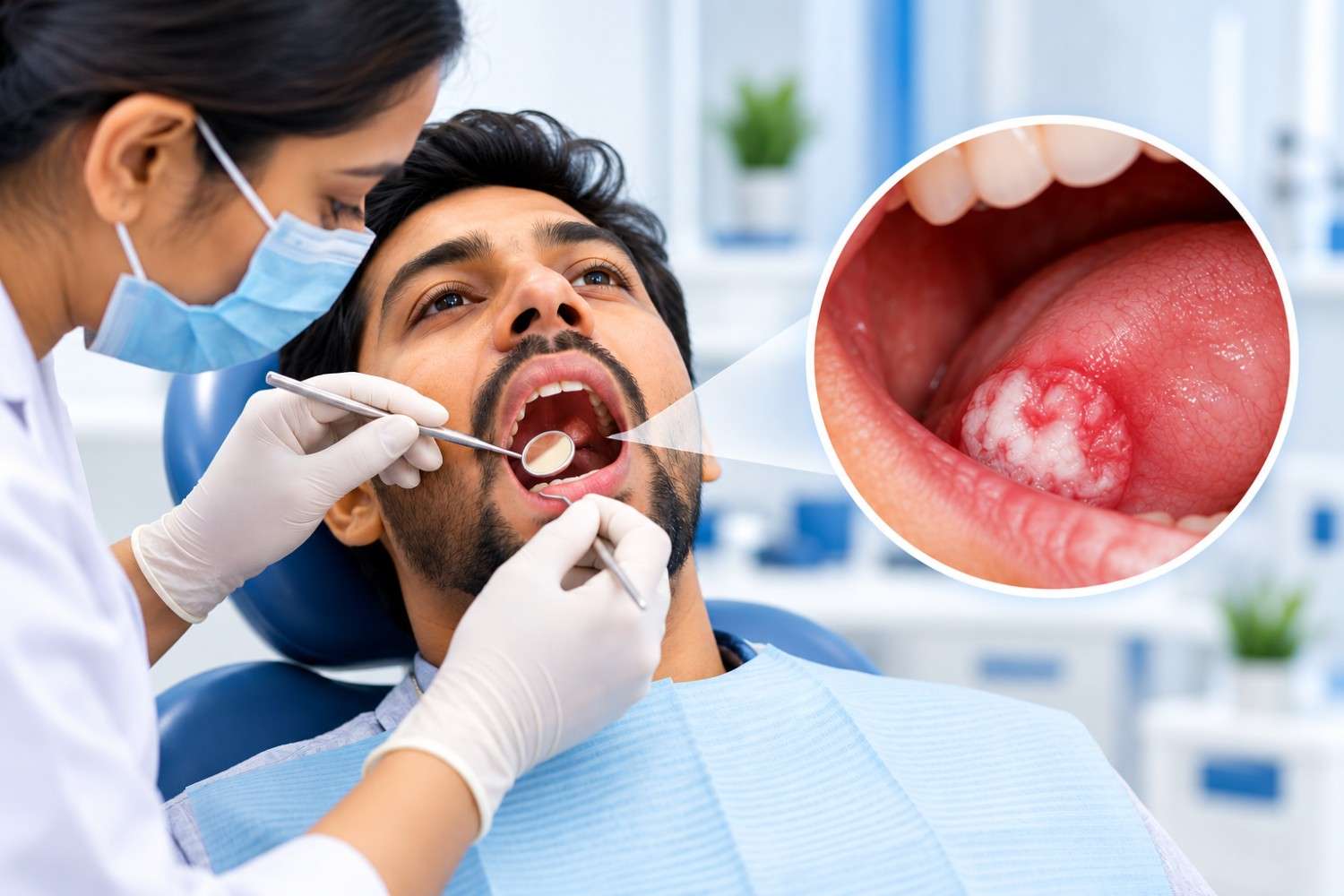
Oral cancer often begins as a small, painless change in the mouth, so many people ignore it for months. By the time pain or difficulty swallowing appears, the disease may already have spread. In India, oral cancer is among the most common cancers in men, largely because of widespread tobacco and areca nut use. The mouth is easy to examine, though, and cancer found early is far more treatable.
What Is Oral Cancer?
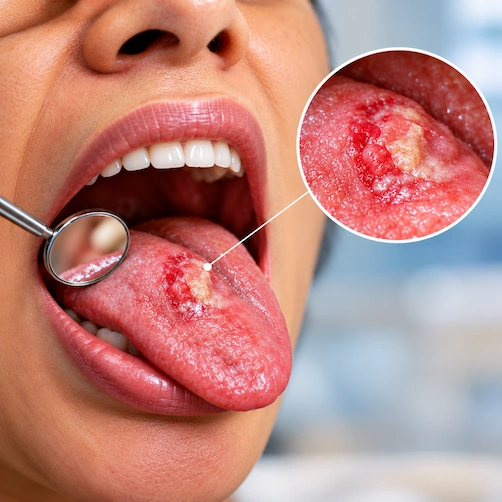
Oral cancer is an abnormal growth of cells in the mouth. It can develop on the lips, tongue, gums, inner lining of the cheeks, floor of the mouth, or hard palate. Cancers of the oropharynx, the part of the throat that includes the tonsils and the base of the tongue, are often discussed alongside it. Most are squamous cell carcinomas, which arise from the thin cells lining the mouth.
Early Signs and Symptoms
Early changes are easily mistaken for minor mouth problems. What sets them apart is persistence. See a doctor if you notice any of the following:
- A mouth ulcer that does not heal within two to three weeks
- A white patch (leukoplakia) or a red patch (erythroplakia) that cannot be wiped away; red patches are more likely to turn cancerous
- A lump, thickened area, or rough spot in the mouth, or a lump in the neck
- Unexplained bleeding, numbness, or pain in the mouth, tongue, or lips
- Difficulty chewing, swallowing, or moving the tongue or jaw
- Loose teeth with no dental cause, or dentures that no longer fit
- A sore throat or voice change that does not settle
- Gradual difficulty opening the mouth fully, a sign of oral submucous fibrosis, a condition linked to areca nut that raises cancer risk.
Risk Factors
Several factors increase the chance of developing oral cancer:
- Tobacco – Smoked forms (cigarettes, bidis) and smokeless forms (gutka, khaini, zarda, tobacco in paan) are the leading causes.
- Areca nut – Chewing areca nut (supari), even without tobacco, is classified by the International Agency for Research on Cancer as carcinogenic to humans.
- Alcohol – Heavy drinking raises the risk, and combined with tobacco, the effect is far greater than either alone.
- HPV infection – Human papillomavirus, especially type 16, is linked mainly to cancers of the oropharynx.
- Sun exposure – Prolonged exposure increases the risk of lip cancer.
- Chronic irritation – Sharp or broken teeth, poorly fitting dentures, and poor oral hygiene may contribute.
- Age and sex – Most cases occur after the age of 40, and men are affected more often.
- General health – A diet low in fruit and vegetables, a weakened immune system, and a family history of cancer add to the risk.
Some people with none of these factors still develop oral cancer, so any persistent change deserves attention.
Screening and Early Detection
Screening looks for changes in the mouth before symptoms appear. For oral cancer, it is quick, painless, and needs no special equipment. A large trial in Kerala found that oral visual screening reduced deaths among people who used tobacco and alcohol.
What happens during a screening examination:
- The doctor or dentist inspects the lips, tongue, inner cheeks, gums, floor of the mouth, palate, and throat under good light.
- The tissues are felt for lumps, thickened areas, or rough patches.
- The lymph nodes in the neck are checked for swelling.
Who needs it most, and how often:
Adults aged 30 and above who use tobacco, areca nut, or alcohol should have an oral examination every year, or as their doctor advises. Others can be checked during routine dental visits. A preventive health check-up is a convenient way to include this examination.
Monthly self-examination at home:
- Stand in front of a mirror with a bright light.
- Inspect the lips, gums, and inner cheeks.
- Check the top, sides, and underside of the tongue.
- Look at the floor and roof of the mouth.
- Feel under the jaw and along the neck for lumps.
Self-examination does not replace a professional check, but it helps you notice changes sooner.
If something looks suspicious:
Screening cannot confirm cancer. A persistent patch, ulcer, or lump needs a biopsy, in which a small tissue sample is examined under a microscope by a pathologist. Imaging tests may follow to determine how far the disease has spread. These steps give the doctor the information needed to plan the next stage of care.
How to Lower Your Risk
Stop using tobacco and areca nut in every form; the risk falls steadily over the years after quitting. Limit or avoid alcohol. Ask your doctor about HPV vaccination, which helps prevent infections linked to some throat cancers. Protect your lips from the sun, have sharp teeth and ill-fitting dentures corrected, visit a dentist regularly, and eat plenty of fruit and vegetables.
When to See a Doctor
Any sore, patch, or lump in the mouth that lasts longer than two to three weeks needs a medical examination, even if it does not hurt. Most mouth changes are harmless, but only a doctor can confirm that. A consult with a doctor can bring clarity early, and further tests can be arranged if the findings call for them.
Oral cancer is one of the few cancers you can see and feel in its early stage. If you have risk factors or a symptom that is not going away, do not wait for pain. Book an appointment today.
Frequently Asked Questions
- What are the first signs of oral cancer?
The earliest signs are usually a non-healing mouth ulcer, a white or red patch, or a painless lump. Any change lasting beyond three weeks needs examination. - Can a mouth ulcer be oral cancer?
Rarely. Most ulcers are harmless and heal within one to two weeks. An ulcer that persists beyond three weeks should be examined by a doctor. - Is oral cancer painful in the early stage?
Often it is not. Many early lesions cause no pain, so a painless sore that does not heal still needs evaluation. - Can non-smokers get oral cancer?
Yes. Areca nut, alcohol, HPV infection, chronic irritation, and genetic factors can cause oral cancer in people who have never smoked. - How is oral cancer diagnosed?
Diagnosis begins with a clinical examination, followed by a biopsy to confirm cancer. Imaging tests then assess how far it has spread. - Is oral cancer curable if detected early?
Outcomes are considerably better when it is found early, and many early-stage cases can be treated successfully. Treatment depends on the stage and location.
This article is for general awareness and does not replace medical advice. Read our medical disclaimer.